
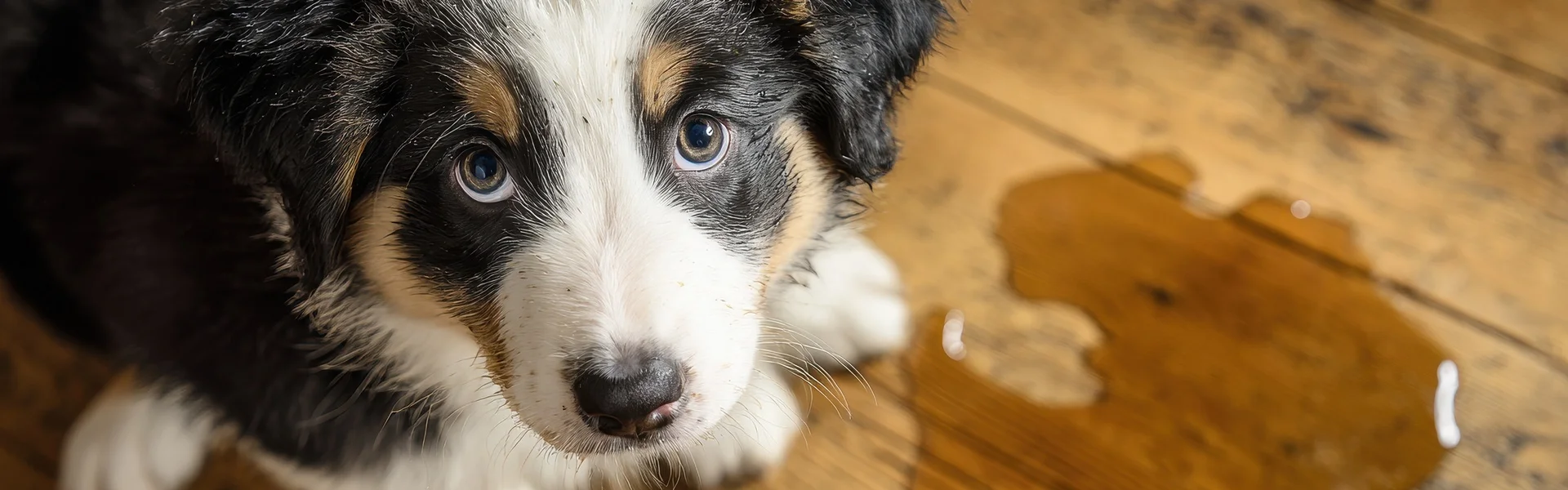
Puppy Potty Training Guide for Clarksville, TN Owners
Science-backed methods to housebreak your puppy in as little as 2 weeks — from Clarksville's #1 rated dog trainer with 1,500+ successful transformations
Potty training a puppy typically takes 4-6 months with consistent effort, though significant progress can be achieved within 2 weeks using proper techniques. The key is understanding that puppies can hold their bladder for approximately one hour per month of age (a 3-month-old can wait 3 hours), combined with crate training, consistent scheduling, and positive reinforcement. Most puppies develop full bladder control between 4-7 months of age.
If you've recently welcomed a new puppy into your Barkers Mill Road, Glenellen, Hilldale, St. Bethlehem, or Trenton Road Corridor home, you're probably wondering how to potty train them effectively — and how long you'll be cleaning up accidents.
The good news? With the right approach, your puppy can be reliably housebroken much faster than most people expect. As a Marine Corps veteran and professional dog trainer who has worked with hundreds of puppies across the Clarksville area, I've refined a potty training system that combines military-level consistency with scientifically-proven positive reinforcement techniques.
This comprehensive guide will give you everything you need to successfully housebreak your puppy — the same methods we teach in our professional puppy training programs.
Understanding Puppy Bladder Development
Before diving into training techniques, it's crucial to understand why puppies have accidents in the first place. Contrary to popular belief, most accidents aren't behavioral — they're physiological.
🔬 What Research Tells Us
According to veterinary research from the Ohio State University Indoor Pet Initiative, puppies are born with an immature urinary system. Their bladder muscles, sphincter control, and the neural pathways responsible for voluntary bladder control don't fully develop until approximately 4-6 months of age.
Here's what this means for you as a puppy parent:
🐾 Key Developmental Facts
- 0-3 weeks: Puppies cannot control elimination at all — mother dogs stimulate them to go
- 3-8 weeks: Puppies begin developing some control but still need help
- 8-16 weeks: Puppies can begin learning where to eliminate but have limited holding capacity
- 4-6 months: Full voluntary bladder control develops
- 6-12 months: Puppies can hold it longer but still need consistent reinforcement
The "one hour per month of age" rule provides a helpful guideline: a 2-month-old puppy can reasonably hold their bladder for about 2 hours, a 3-month-old for 3 hours, and so on, up to a maximum of about 8 hours for adult dogs.
⚠️ Important Warning
Never expect a young puppy to "hold it" longer than their physical development allows. Forcing them to do so can cause urinary tract infections, anxiety, and actually delay successful potty training. If accidents are happening, it's almost always a management issue — not a behavioral one.
The Science Behind Successful Housebreaking
Effective potty training isn't about punishment or "showing the dog who's boss." Modern canine behavioral science has given us proven methods that work faster and create better long-term results.
Three Core Principles
1. Natural Den Instincts
Dogs have an innate instinct to avoid soiling their sleeping and eating areas. This is why crate training is so effective — when properly sized, a crate leverages this natural behavior to help puppies develop bladder control faster.
2. Positive Reinforcement Timing
Research consistently shows that rewards given within 3 seconds of a desired behavior create the strongest learning associations. When your puppy eliminates in the correct spot, immediate treats and praise are far more effective than praise given once you're back inside.
🔬 Research Finding
A study published in the Journal of Veterinary Behavior found that punitive training methods are associated with increased anxiety and confusion in dogs, which can actually hinder the housebreaking process. Positive reinforcement produces faster, more reliable results.
3. Consistency Creates Habits
Dogs learn through repetition and association. Taking your puppy to the same spot, using the same command, and maintaining the same schedule creates powerful neural pathways that make outdoor elimination automatic.
As professional trainers, we emphasize that housebreaking is approximately 98% prevention and 2% active training. Your job is to prevent accidents by managing your puppy's environment and schedule, then reward them heavily when they get it right.
Age-Based Potty Training Schedule
Consistency is everything in potty training. Here's a comprehensive schedule based on your puppy's age:
| Puppy Age | Maximum Holding Time | Daytime Potty Breaks | Nighttime Breaks |
|---|---|---|---|
| 8-10 weeks | 1-2 hours | Every 45-60 minutes | Every 2-3 hours |
| 10-12 weeks | 2-3 hours | Every 75 minutes | Every 3-4 hours |
| 3-4 months | 3-4 hours | Every 90 minutes | Every 4-5 hours |
| 4-6 months | 4-6 hours | Every 2-3 hours | Usually sleeps through |
| 6+ months | 6-8 hours | Every 3-4 hours | Sleeps through night |
Pro Tip from Jacob
In addition to scheduled breaks, always take your puppy outside immediately after: waking up from sleep or naps, eating or drinking, active play sessions, any excitement (visitors arriving, etc.), and before bedtime. These are the highest-risk times for accidents.
Creating Your Daily Routine
Here's a sample schedule for a 10-week-old puppy:
| Time | Activity | Notes |
|---|---|---|
| 6:00 AM | Wake up → Immediately outside | Carry puppy to prevent accidents |
| 6:15 AM | Breakfast | Feed in crate or designated area |
| 6:30 AM | Outside potty break | 15-30 minutes after eating |
| 7:30 AM | Supervised playtime | Keep eyes on puppy at all times |
| 8:00 AM | Outside potty break | After play = high accident risk |
| 8:15 AM | Crate time/nap | Puppies need 18-20 hours sleep |
| 10:00 AM | Wake up → Outside immediately | Repeat cycle throughout day |
This cycle of potty → eat/play → potty → crate → repeat forms the foundation of successful housebreaking.
Crate Training for Faster Results
When done correctly, crate training can cut your potty training timeline in half. This isn't about confinement — it's about leveraging your puppy's natural instincts.
Why Crate Training Works
Dogs are naturally den animals. In the wild, wolves and wild dogs seek out small, enclosed spaces to rest and raise their young. This instinct means your puppy has an inherent desire to keep their "den" clean.
A properly-sized crate is just large enough for your puppy to:
- Stand up fully without ducking
- Turn around comfortably
- Lie down stretched out
⚠️ Crate Sizing Matters
If the crate is too large, your puppy may eliminate in one corner and sleep in another — defeating the purpose. Use dividers in larger crates to adjust the size as your puppy grows. If your puppy is consistently soiling their crate, it may be a sign of separation anxiety — contact a professional trainer for guidance.
Making the Crate a Happy Place
🏠 Crate Training Essentials
- Feed all meals inside the crate to create positive associations
- Offer high-value treats when puppy enters voluntarily
- Place a comfortable bed or blanket inside (remove if puppy chews)
- Never use the crate as punishment
- Start with short periods and gradually increase duration
- Cover with a blanket to create a cozy den atmosphere
For comprehensive crate training guidance combined with housebreaking, our puppy training program covers everything you need to establish these foundational skills.
Step-by-Step Potty Training Method
This is the exact method we use with clients at Off Leash K9 Training Clarksville. Follow these steps consistently, and you'll see results.
Establish Your Designated Potty Area
Choose a specific spot in your yard for elimination. This spot should be:
- Easily accessible (short walk from the door)
- Away from high-traffic play areas
- Consistent — always use the same spot
Dogs develop both visual and olfactory associations with their potty spot. Taking them to the same place creates a powerful cue that says "this is where we go."
Use a Consistent Command
Choose a phrase like "Go potty," "Do your business," or "Hurry up" and use it every single time your puppy is in position to eliminate. Say it calmly and repeat until they go.
Over time, this verbal cue becomes a powerful trigger that tells your puppy exactly what you expect.
Reward Immediately and Enthusiastically
The moment — and I mean the exact moment — your puppy finishes eliminating outside:
- Praise with an excited, happy voice ("Good potty! What a good dog!")
- Give a high-value treat (tiny pieces of chicken, cheese, or liver treats work great)
- Keep treats in your pocket or by the door so you're always prepared
This immediate positive reinforcement creates a powerful reward pathway in your puppy's brain. They learn that going outside = amazing things happen.
Supervise Constantly When Out of the Crate
This is where most people fail. When your puppy is out of the crate:
- Keep them in the same room as you at all times
- Use baby gates to prevent wandering
- Consider keeping them on a leash attached to your belt
- Watch for pre-elimination signals (covered in next section)
If you can't watch your puppy with 100% attention, they should be in the crate. No exceptions.
Maintain a Consistent Feeding Schedule
What goes in on schedule comes out on schedule. Feed your puppy at the same times every day:
- Puppies under 4 months: 3-4 meals per day
- Puppies 4-6 months: 3 meals per day
- Puppies 6+ months: 2 meals per day
Avoid free-feeding (leaving food out all day). This makes potty timing unpredictable.
Manage Water Intake Strategically
While you should never restrict water access during the day (this can cause health issues), you can manage timing:
- Offer water after meals and play sessions
- Pick up the water bowl 2 hours before bedtime
- Always take puppy out after they drink a significant amount
The Overnight Advantage
Puppies can often hold it longer at night because their metabolism slows during sleep. By 4 months, most puppies can sleep through the night (6-8 hours) without a potty break. Until then, set alarms to take them out during the night — it's worth the short-term sleep disruption.
Recognizing When Your Puppy Needs to Go
Prevention is everything. Learn to recognize these pre-elimination behaviors and you can get your puppy outside before accidents happen:
🚨 Watch for These Warning Signs
- Sniffing the ground intensely — looking for a spot
- Circling or spinning — getting into position
- Whining or pawing at the door — trying to tell you
- Restlessness or pacing — something's up
- Suddenly stopping play — urgency taking over
- Squatting — you have about 1 second!
- Heading to a corner or behind furniture — seeking privacy
The moment you see any of these signs, calmly pick up your puppy (or grab their leash) and head straight outside. If you're too late, don't worry — we'll cover how to handle accidents correctly.
Teaching Your Puppy to Signal
Some puppies naturally learn to signal at the door, while others need help. You can teach a bell-ringing behavior:
- Hang a bell on the door handle at puppy nose height
- Before each potty trip, guide your puppy to touch the bell with their nose (use a treat to lure them)
- Immediately open the door when the bell rings
- After several weeks, your puppy will ring the bell to go out
⚠️ Important Note
Don't teach bell ringing until your puppy is already reliably going outside. Otherwise, they may learn to ring the bell just to go play, which undermines the potty-specific purpose.
Handling Accidents the Right Way
Accidents will happen — it's a normal part of the learning process. How you respond makes a huge difference in your puppy's progress.
If You Catch Them in the Act
- Interrupt calmly — Say "Oops!" or "Outside!" in a neutral tone
- Pick up puppy immediately — Get them outside as quickly as possible
- Take to the potty spot — Use your command phrase
- Reward if they finish outside — Even if it's just a little bit
- Clean up inside properly — More on this below
If You Find an Accident After the Fact
This is critical: Do nothing to the puppy. Simply clean it up.
🔬 Why Punishment Doesn't Work
Dogs have approximately a 3-second window to connect a consequence with a behavior. If you find an accident even 30 seconds after it happened, your puppy has already moved on mentally. Punishment at this point only creates fear and confusion — they literally don't understand why you're upset. Research from the American Veterinary Society of Animal Behavior confirms that punitive methods hinder housebreaking progress.
Cleaning Accidents Properly
This is one of the most overlooked aspects of potty training. Dogs have 300 million olfactory receptors compared to our 6 million. They can smell residual urine long after you think it's gone — and they're attracted to eliminate in spots they've used before.
🧹 Proper Cleaning Protocol
- Use enzyme-based cleaners only — Products like Nature's Miracle or Rocco & Roxie contain enzymes that break down uric acid crystals
- Blot, don't rub — Rubbing spreads the urine deeper into carpet fibers
- Soak the area thoroughly — The cleaner needs to reach everywhere the urine did
- Avoid ammonia-based cleaners — These smell similar to urine and can attract dogs to eliminate in the same spot
- Consider a blacklight — UV lights reveal old urine spots you might have missed
Troubleshooting Common Problems
Problem: Puppy Has Accidents in the Crate
Possible causes:
- Crate is too large — use a divider to reduce space
- Puppy was left in crate too long for their age
- Medical issue (UTI, parasites) — see your vet
- Separation anxiety — requires behavioral intervention
- Puppy came from pet store or situation where they had to soil their living space
Problem: Puppy Goes Right After Coming Inside
Solutions:
- Stay outside longer (15-20 minutes minimum)
- Walk around — movement stimulates elimination
- Keep puppy on leash inside until they've gone outside
- Don't rush back in — some puppies get distracted and forget to go
Problem: Puppy Won't Go in Rain/Cold Weather
Solutions:
- Create a covered potty area if possible
- Use a dog raincoat for toy breeds
- Go out with them — they feel safer with you there
- Shovel a potty path in snow
- Be patient — they will eventually have to go
Problem: Regression After Doing Well
Setbacks are normal! Common triggers include:
- Changes in routine (new schedule, visitors, moving)
- Illness or digestive upset
- Teething (4-6 months)
- Adolescent "testing" phase
The solution is always the same: go back to basics. Increase supervision, go back to the strict schedule, and praise heavily for success.
If problems persist, rule out medical issues first with your veterinarian. For behavioral challenges, our board and train program provides intensive, professional intervention.
Special Considerations for Small Breeds
You may have heard that small dogs are harder to potty train. There's some truth to this — but it's not for the reasons most people think.
🔬 What Research Actually Shows
A study in the Journal of Veterinary Behavior found that only 66.8% of small dogs were completely house-trained compared to 95% of large dogs. However, researchers attributed this to owner behavior, not physical limitations. Small breed owners are statistically less likely to walk their dogs regularly and more likely to rely on indoor potty pads.
The reality: Small dogs can be trained just as reliably as large dogs using the same methods. They may need slightly more frequent potty breaks due to faster metabolism, but their bladder-to-body ratio is proportional.
Tips for Small Breed Success
- Don't make excuses — hold them to the same standards
- Take them outside more frequently initially (every 45-60 minutes for young puppies)
- Watch more closely — small accidents are easier to miss
- Treat them like dogs, not babies — they need structure too
- Avoid long-term reliance on indoor pads
📚 Related Training Resources
Continue your puppy training journey with these helpful guides:
Frequently Asked Questions
Most puppies can be reliably potty trained within 4-6 months with consistent training. However, with intensive, structured training methods like those used at Off Leash K9 Training, many puppies show significant improvement within 2 weeks. Full bladder control typically develops by 6-7 months of age, according to veterinary research.
You can begin potty training as soon as you bring your puppy home, typically around 8 weeks of age. However, puppies don't develop full bladder control until 4-6 months old. Between 12-16 weeks, puppies have developed enough bladder and bowel control to begin making significant progress with housebreaking.
The general rule is puppies can hold their bladder for approximately one hour per month of age. A 2-month-old puppy needs to go out every 2 hours, a 3-month-old every 3 hours, and so on. Always take puppies out immediately after waking, after eating, after playing, and before bedtime.
Common reasons for indoor accidents include: insufficient supervision, irregular feeding schedules, medical issues like urinary tract infections, anxiety, or not cleaning previous accidents with enzyme cleaners. Research shows that 98% of successful housebreaking is prevention through proper supervision and scheduling.
Puppy pads can be useful for apartment dwellers or during extreme weather, but they can slow outdoor training by teaching puppies that indoor elimination is acceptable. If you use them, place pads near the door and gradually move them outside to transition to outdoor-only elimination.
While not absolutely required, crate training significantly accelerates potty training success. Dogs have a natural instinct to keep their sleeping area clean. When properly sized (just large enough to stand, turn, and lie down), crates leverage this instinct to help puppies develop bladder control faster.
If you catch your puppy mid-accident, calmly interrupt with a neutral sound like "Oops!" and immediately take them outside to their designated potty area. Praise and reward if they finish outside. Never punish or scold — research shows punitive methods increase anxiety and can worsen housebreaking problems.
Research published in the Journal of Veterinary Behavior found that smaller dogs are statistically less likely to be completely house-trained (66.8%) compared to larger dogs (95%). However, this difference is often due to inconsistent training rather than physical limitations. Small dogs benefit from the same structured approach as large breeds.
Professional puppy training packages in Clarksville typically range from $150-$300 for private lesson packages that include potty training guidance. Board and train programs that include comprehensive housebreaking range from $1,500-$2,500 depending on duration. Off Leash K9 Training offers puppy lessons specifically designed for housebreaking and basic obedience.
Yes, adult dogs can absolutely be potty trained using similar methods as puppies. Adult dogs have better bladder control, which can actually make training faster. The key is establishing clear routines, proper supervision, and ruling out any medical issues that might cause accidents.
Jacob Robinson
Professional Dog Trainer & Marine Corps Veteran
Jacob brings 9 years of Marine Corps experience, including 6 years as a MARSOC multi-purpose canine handler with 3 combat tours. After his military service, he served as lead instructor at Vohne Liche Kennels before founding Off Leash K9 Training Clarksville. He has trained hundreds of dogs across every breed and behavior challenge.
Need Help With Puppy Training?
Get personalized guidance from Clarksville's most trusted dog trainer. Our puppy programs cover potty training, crate training, basic obedience, and socialization — everything your puppy needs for a great start.
View Training PackagesOr call for a free consultation: (615) 905-6559
📍 Serving All of Clarksville & Surrounding Areas
We provide professional puppy training services throughout:
Follow us for daily dog training tips: